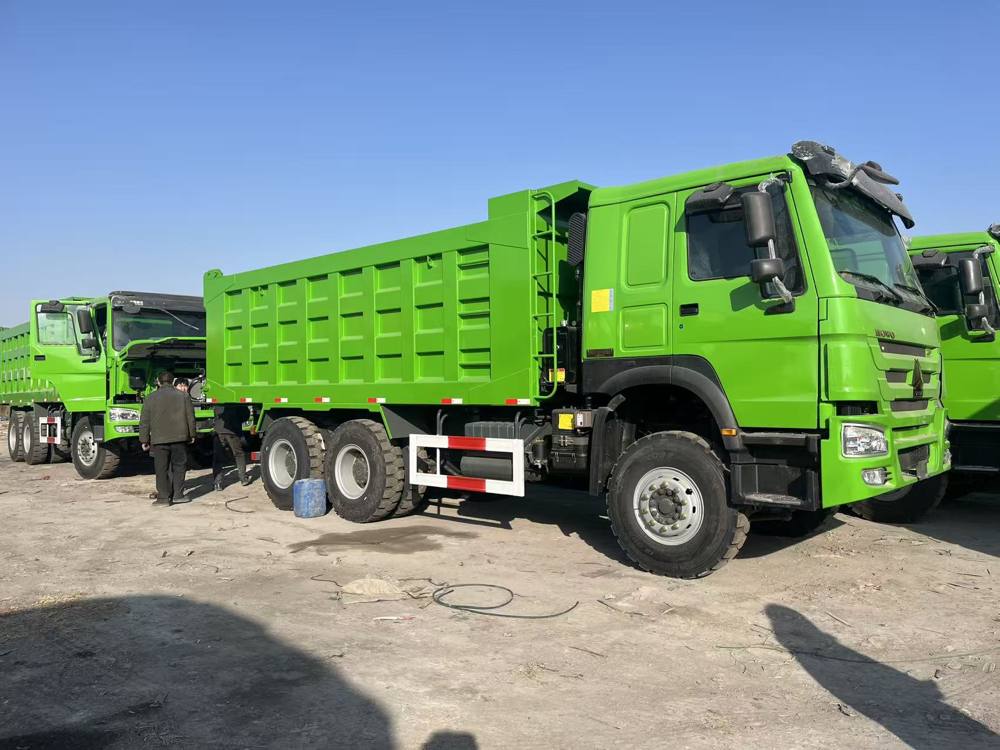
Start with the job, not the axle count
Our used and remanufactured HOWO and SHACMAN dump trucks come in both 6x4 and 8x4 versions. Most of our stock is 6x4, but we regularly source 8x4 units for quarry and mining customers. This guide explains what each layout actually changes, so you can tell us the job and we can match the truck to it.
What 6x4 and 8x4 actually mean
The first number counts wheel positions and the second counts how many of them are driven. A 6x4 has three axles: one steering front axle and two driven rear axles. An 8x4 has four axles: two steering front axles and the same two driven rear axles.
So an 8x4 does not have more driven wheels than a 6x4. What it adds is a second front axle. That extra axle lets the chassis carry a longer body and spreads the load over more axles. The cost is a heavier truck, more tyres to buy and replace, and usually a higher purchase price.
Where a 6x4 dump truck works best
A 6x4 is the shorter, more manoeuvrable truck. With one steering axle it has a tighter turning circle, which matters on narrow access roads, crowded loading points and road construction sites where the truck has to turn around between an excavator and live traffic.
It also has fewer tyres, so tyre and routine maintenance costs are usually lower. For mixed work, such as delivering sand and gravel to building sites in the morning and hauling road base in the afternoon, a 6x4 is often the more flexible choice. This is why it is the most common dump truck in our yard and on many African fleets.
Where an 8x4 dump truck earns its place
An 8x4 is built for repeated heavy loads over short, controlled distances. Inside a quarry or a mine, where the truck shuttles between the crusher, the pit and the stockpile all day, the longer body and the load spread over four axles can make each trip more productive.
The trade-off shows up when the work changes. A longer truck needs more space to turn and position under the loader. It is heavier when empty, and every extra tyre is another cost at replacement time. If your site has tight corners or the truck will spend much of its time on public roads, check carefully that the extra capacity will actually be used.
Five questions to answer before you choose
Write down your answers to these before you ask for quotes. They will decide the configuration faster than any brochure.
First, what does the truck carry on a normal trip? Think about what a typical day looks like, not the heaviest load you might carry once a month.
Second, what is the road surface? Dirt tracks, loose gravel and paved roads put different demands on the truck, and wet-season conditions can change a route completely.
Third, how steep are the grades, loaded and empty? Long climbs out of a pit affect which truck and drivetrain make sense.
Fourth, how much space is there at the loading and tipping points? If the truck has to turn in a tight spot, the shorter 6x4 is easier to handle.
Fifth, will the truck run on public roads? Axle load limits differ from one country to another. Check the current rules in your destination country before you decide, especially if you plan to run an 8x4 fully loaded on highways.
Match the body and hoist to the material
The chassis is only half of a dump truck. The body and tipping system have to suit what you carry. Stone and ore are heavy and abrasive, sand and soil are lighter but can stick, and each behaves differently when it is tipped.
Ask about the body shape, such as a U-shaped body or a rectangular box, and about the floor and side plate thickness. Ask how the hoist was checked during refurbishment. Our guide to inspecting a used dump truck covers what to look for.
Parts and workshops matter as much as the spec
Before choosing, ask the workshops near your site what they service most often and which parts they keep in stock. A truck that waits a week for a part is not cheap to run, whatever its capacity. HOWO and SHACMAN trucks are both widely used across African markets, but local experience with a particular configuration varies by country and region.
If you already run 6x4 trucks, adding another 6x4 keeps your tyres, parts and driver training consistent. Adding a first 8x4 makes sense when the job clearly needs it, not only because it is available.
Compliance and how a purchase runs
Two practical checks come before any money moves.
First, compliance. Tanzania, Kenya, Mozambique and Malawi do not allow left-hand-drive vehicles to be imported, so confirm the steering position and current import rules for your country before you shortlist a truck. Vehicle age limits and other rules also vary, so check them with your clearing agent.
Second, the purchase itself. Before you pay, we send photos, video and a condition report for the exact truck, and you can arrange a third-party inspection. Payment is a 30% deposit, with the remaining 70% paid before the truck leaves the factory. CRTA's buyer service fee is 3% of the transaction value. We quote CIF to your port. Exact specifications differ from truck to truck, so ask us for the exact specification of each truck you are considering.
Next steps
Send us your route, material and site conditions on WhatsApp (+86 180 0351 2924) and we will tell you which configuration fits the job and point you to the right units. You can also browse the used dump trucks for sale page, the trucks in stock page with real photos, and the recent shipments page with loading videos.
FAQ: Is an 8x4 always better for heavy loads?
No. An 8x4 suits repeated heavy loads over short, controlled hauls with enough space to manoeuvre. On tight sites, mixed work or routes with strict axle limits, a 6x4 is often the better fit.
FAQ: Can I mix 6x4 and 8x4 trucks in one fleet?
Yes, and many contractors do: 8x4 trucks for the quarry or pit work and 6x4 trucks for deliveries and road jobs. Plan for the extra tyre sizes and parts the mix requires.