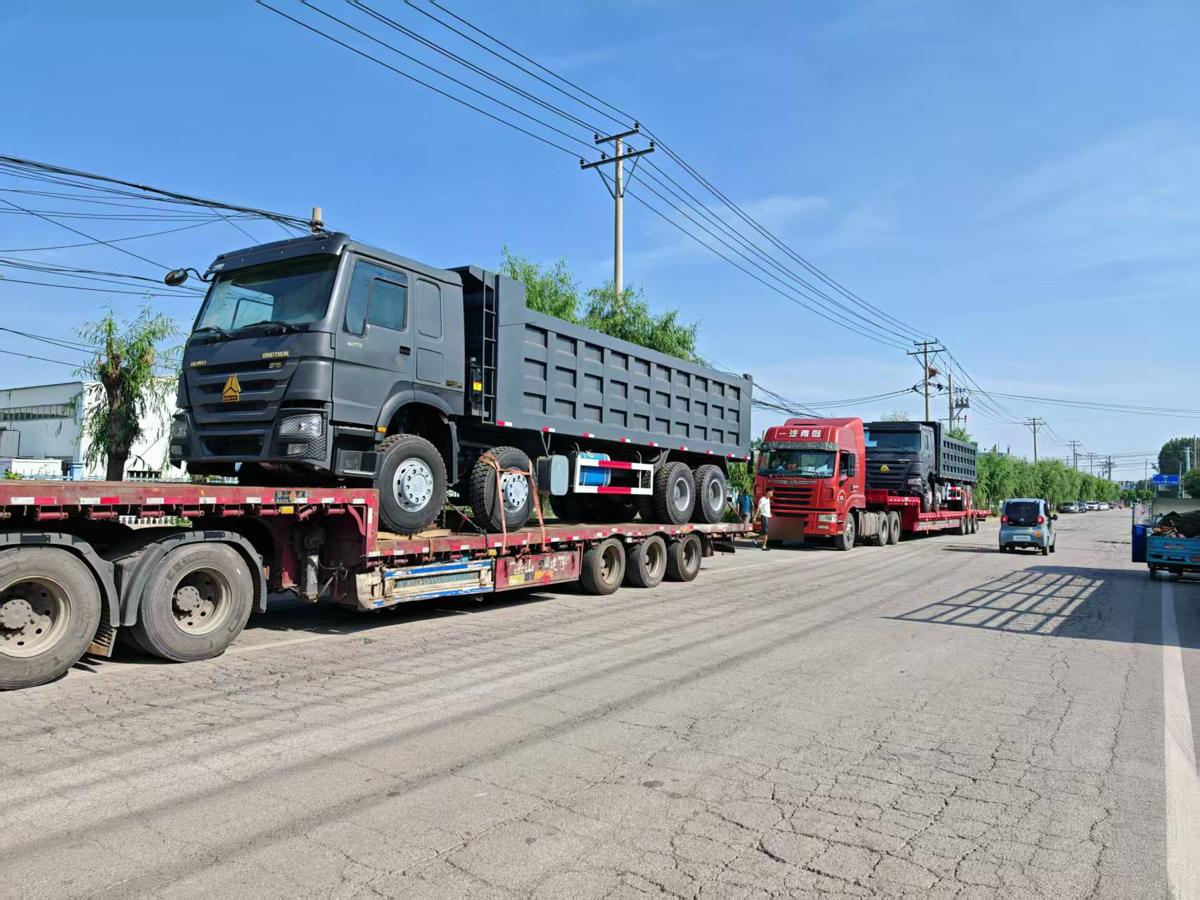
If you have ever quoted a used truck for export and watched the buyer compare it against a domestic listing for the same model, you already know the number means nothing on its own. Export pricing layers in costs and risks that domestic sales never face. The question is not "what is this truck worth" but "what does it cost to put this truck to work in the buyer's market." The answer depends on six variables, and missing any one of them is where deals fall apart or margins disappear.
Vehicle Condition and Refurbishment Set the Price Floor
Vehicle Condition and Refurbishment Set the Price Floor
Condition is not just mileage or paint. It is a forecast of what the buyer will spend before the truck earns anything. A practical way to think about it: price the truck as if you were the one receiving it at the destination port with no local mechanic and no spare parts shelf behind you.
The three systems that matter most in pricing judgment are the engine, transmission, and rear axle. If you have full maintenance records - oil changes, filter replacements, any rebuild receipts - you have documentation that lets you price in the upper range of the condition bracket. If records are spotty or missing, expect buyers to discount heavily, often more than the actual repair risk warrants, because uncertainty itself is a cost to the buyer.
Refurbishment grade is where many sellers either recover cost or leave money on the table. Standard reconditioning (safety items, tires, brakes) addresses roadworthiness. Full reconditioning adds cosmetic and comfort items. Remanufactured-grade refurbishment typically addresses major drivetrain components. The grade you choose should match what the destination market actually values - paying for remanufactured-grade work on a truck going to a market that only cares about running cost is margin wasted. Ask the buyer what they actually need before quoting.
A useful judgment checkpoint: if the cost of the refurbishment you are planning exceeds 15-20% of the truck's target sale price, pause and re-evaluate whether the grade is right for this buyer, or whether a lower grade at a lower price point would close faster. The exact threshold varies by model and market, but the principle holds - over-refurbishing can hurt as much as under-refurbishing.
Destination Market Determines Premium or Discount
Destination Market Determines Premium or Discount
The single biggest pricing mistake is assuming one truck equals one price. The same 6x4 dump truck can be a fast mover in Lagos and dead stock in Almaty, depending on what buyers there actually run. Before setting a number, spend time understanding the target market: what horsepower range do local fleets prefer? What drivetrain configuration? What axle ratio works for their road conditions?
Entry barriers create the pricing gap. When a country tightens emission standards or lowers the vehicle age limit, the pool of legally importable trucks shrinks. Compliant trucks gain pricing power; non-compliant ones become discounted inventory or go to markets with looser rules. This is not theoretical - it plays out every time regulations change. Check the destination country's current rules through official channels or the buyer's customs broker before you set the quote, because these rules shift.
Local supply matters too. If three other Chinese exporters are already shipping the same model to the same port this month, your pricing room shrinks. If yours is the only one with that configuration, you have leverage. A practical step: before quoting, ask your logistics partner or the buyer what has been landing at that port recently.
The judgment question to sit with: is this truck a commodity in the target market, or is it scarce? If it is scarce, price for the value of being the only option. If it is a commodity, price competitively and make up margin on volume.
Shipping Method and Freight Deserve Their Own Line
Shipping Method and Freight Deserve Their Own Line
Freight is often the second-largest cost after the truck, yet it is the most commonly glossed-over line item. The practical reason sellers lump it into the truck price is simplicity - but that creates problems when freight rates shift between quoting and departure.
RoRo works well for a single truck or a uniform batch heading to a port with regular RoRo service. Container shipping becomes more cost-effective when you are mixing trucks with spare parts, or when the destination port lacks RoRo options. A rough way to decide: under 3 trucks to a RoRo-served port, RoRo is usually simpler; over 5 trucks or mixed cargo, price both options and compare.
On freight costs, a practical rule: never quote the exact freight number. Build in a buffer of 5-10% for rate fluctuations [this range is a working estimate and varies by route and season - confirm with your forwarder for current rates]. Peak-season surcharges around Q4 and Chinese New Year can push rates up further. And always list freight as a separate line on the quote - this keeps the truck price clean, makes rate adjustments easier later, and prevents the classic "I thought shipping was included" dispute.
Documentation and Compliance Are Real Costs, Not Paperwork
Documentation and Compliance Are Real Costs, Not Paperwork
Experienced exporters know that documentation problems surface at the worst possible time - at the port of loading or worse, at the destination port. Title transfer, de-registration, and export customs clearance each carry fees that vary by province and jurisdiction. Build these into your cost base before pricing, not after.
Compliance rectification is the hidden cost line most likely to blow up a margin. If the truck needs reflective tape, lighting upgrades, or emission-related work to meet destination rules, that is real money and real time. The judgment call here: if rectification costs exceed a level you are comfortable absorbing (and the buyer will not cover them), it may be better to route the truck to a market with looser requirements rather than force a bad deal.
Third-party inspection reports (from agencies like SGS, BV, or CCIC) are required by some destination countries and not others. Confirm the requirement early - do not assume. The cost of an inspection report is small compared to the cost of a shipment that gets rejected at the border.
Exchange Rate and Payment Terms Affect What You Actually Keep
Exchange Rate and Payment Terms Affect What You Actually Keep
A quote is a promise. Payment is reality. The 30 to 90 days between them is a window where exchange rates move, and the profit you calculated on paper may not be the profit that lands in your account.
Lock the rate in the contract, or agree on an adjustment mechanism tied to a reference rate. The choice between Telegraphic Transfer and Letter of Credit is a risk trade-off: T/T is flexible and faster but depends on buyer creditworthiness; L/C provides bank-level security but adds fees and processing time. A practical approach for first-time buyers: start with a higher deposit (say 50%) with T/T balance before shipment. For established buyers with track record, 30/70 terms with a locked rate work well. The exact split depends on your relationship and risk tolerance.
Batch Size and Negotiation Room Define the Final Number
Batch Size and Negotiation Room Define the Final Number
Unit pricing scales with volume - but not linearly. A single truck carries all the fixed costs: documentation, logistics coordination, prep management. A 10-truck order spreads those across 10 units. The judgment call is knowing at what batch size the fixed-cost savings become meaningful enough to pass on as a discount.
Negotiation room is both art and math. Leave enough room that the buyer feels they won something, but not so much that you are leaving real margin behind. In practice, most experienced exporters build in 5-8% negotiation buffer into the initial quote [this varies widely by market and relationship - treat as a starting point, not a rule]. And if you are dealing with a repeat buyer, the buffer can be smaller because the trust cost is already paid.
FAQ
FAQ
How much higher is an export quote compared to a domestic sale? There is no fixed ratio. Export pricing adds refurbishment, logistics, documentation, and currency risk on top of the base vehicle value, while also responding to destination market supply and demand. In practice, the uplift varies widely by model and market. The right approach is to calculate costs truck by truck rather than applying a flat markup.
Where is there room to negotiate when a buyer pushes back on price? Typically in three places: refurbishment grade (stepping down from full to standard), batch discounts (offering to include more units), and logistics optimization (switching shipping methods or consolidating cargo). Direct pressure on the truck price has the least flexibility because vehicle condition costs are largely fixed. Know your cost floor before entering negotiations.
What should a professional quote include? At minimum: truck price per unit, itemized refurbishment cost, freight with Incoterms clearly stated (FOB, CIF, etc.), documentation fees, and estimated incidental costs such as port handling or inspection. Itemized quotes reduce the chance of disputes and signal professionalism to buyers.